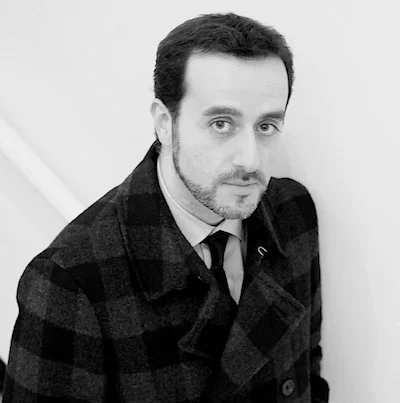
Jean-Philippe Calvin is a composer, conductor, sound artist, and producer — a polymath whose work thrives on the interplay between structure and spontaneity, where mathematical precision meets organic flow. His music unfolds in richly textured soundscapes shaped by complex rhythms, layered temporalities, and spatial nuance, weaving timbral colour, dramaturgical gesture, and live electronics into intricate interference patterns and resonant depth. His compositional style is marked by energetic, virtuosic instrumental writing, sudden shifts of atmosphere, and the seamless fusion of acoustic and electronic materials into unified sonic environments.
Influenced by world music traditions, he integrates modal, rhythmic, and gestural elements into a contemporary language that is at once innovative and deeply rooted in diverse cultures. His background in sound design, encompassing field recordings and sampling, live processing, and spatial experimentation, enables him to craft environments where music becomes a living architecture of sound.
Among his most notable works is the opera La Cantatrice Chauve (2008), inspired by Susan Sontag’s encouragement in the mid-1990s to adapt Eugène Ionesco’s absurdist play into a comic opera. Developed during his residency at the Royal Opera House, Covent Garden, it premiered in 2009 at the Théâtre de l’Athénée-Louis Jouvet in Paris, receiving critical acclaim and the Orphée d’Or (Golden Orpheus) award. The woodwind quintet Kleztet (2007–2008), composed to celebrate film composer Ennio Morricone’s 80th birthday at the Cannes Film Festival, remains one of his most frequently performed chamber works worldwide. His Concerto for Clarinet and Orchestra – Kadosh (2009), commissioned and premiered by David Krakauer and the Orchestre Lamoureux at the Théâtre des Champs-Élysées, blends folkloric vitality and jazz inflections with contemporary orchestral refinement. The completion of cycle Flux I–VII for solo instruments, together with String Quartets II and III (2010–2017), pushes instrumental virtuosity and musical drama to the edge, often enhanced with live electronics. His Danses Concertantes, premiered in 2019, exemplifies his signature spatial orchestral writing.
Jean-Philippe’s creative independence was shaped by formative encounters with diverse masters. He studied composition with Robert Carl, James Sellars, and Iannis Xenakis; electronic music with Gérard Pape, Luc Ferrari, and Curtis Roads; and conducting with Bernard Haitink and Harold Farberman. He also attended masterclasses with Sir Michael Tippett, Gunther Schuller, and John Williams, and collaborated with pioneers of contemporary music such as Karlheinz Stockhausen, Jean-Claude Risset and Jonathan Harvey. Rather than aligning with a single school, he has drawn inspiration from multiple traditions, forging a personal voice that embraces complexity, diversity, and openness across forms and genres.
Until 2014, he was Professor and Research Associate in Contemporary Music at the Royal College of Music, London. For nearly seven years, he led the contemporary music programmes and founded and directed the Variable Geometry Contemporary Music Ensemble. With Variable Geometry, he curated, produced, and conducted concert series that featured numerous world premieres, including major large ensemble, film, and installation works by composers such as John Adams, Pierre Boulez, Iannis Xenakis, Steve Reich, John Cage, and Gérard Grisey, as well as commissioning and premiering works by young emerging composers.
With a Leverhulme Trust award, Jean-Philippe became the first composer-in-residence at the Science Museum London in 2016, where he composed and premiered The Museums of the New Age film soundtrack — exemplifying a landmark in his commitment to multidisciplinary collaboration.
His more recent works include a series of film and media compositions (2020–2023), among them The Leaf of Gold, Breaking the News, The Hero with a Thousand Faces and the Great Escape. He has also created the sound installations Harmonic Disturbances and Ex Natura… (2023–2024), Anniversary Fanfare (2023), as well as the large-ensemble work Corps Sonore (2024–2025).
Today, Jean-Philippe continues to compose, produce, and create across a broad spectrum of genres — from symphonic works and opera to dance, film, and installation. Actively engaged in complex, cross-disciplinary projects and collaborations, he bridges music, sound, media, the arts, science, and technology. With nearly three decades at the forefront of international contemporary music as a composer, performer, and producer, he brings a forward-looking vision to every project — reshaping boundaries, challenging conventions, and expanding the possibilities of musical expression.